


Growth, Rates, and the AI Divide
As expected, 2026 has been a study in resilience: inflation and affordability came back to the fore, a new Chair took the helm at the Fed, and the economy appears to have reaccelerated. The black swan event we did not expect, however was the coordinated war in the Middle East, which carried significant consequences for oil and other commodity prices. Yet despite that complicated backdrop, corporate earnings expectations strengthened, helped by an AI capital spending cycle that has proven even more powerful than many optimistic forecasts anticipated. That combination, geopolitical stress on one side and accelerating earnings support on the other, has defined the year so far and sets up a second half where the central question is whether profit growth can continue to broaden beyond the companies most directly tied to the AI buildout.
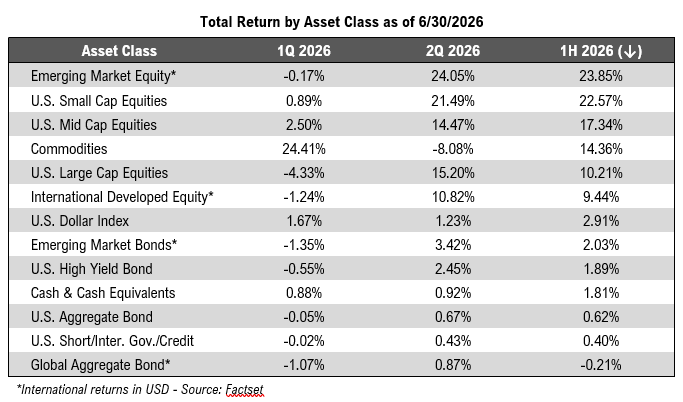
U.S. equities entered the summer with solid gains, helped by resilient earnings and continued enthusiasm for AI infrastructure. International stocks remained competitive, supported by valuation discounts and capital flowing back toward non-U.S. markets. Bonds, meanwhile, benefitted from attractive starting yields, but saw returns tempered by a backup in interest rates.
The first half reminded investors how quickly geopolitics can move from background concern to market driver. The Iran War briefly turned energy from a portfolio footnote into one of the dominant macro variables. Oil prices and shipping costs rose as investors focused on the Strait of Hormuz, declining fuel stockpiles, and the possibility that a regional conflict could become a broader inflation shock. Energy prices do not stay contained inside commodity markets; they ripple through the input costs of all manufactured goods, the food supply chain, and services.
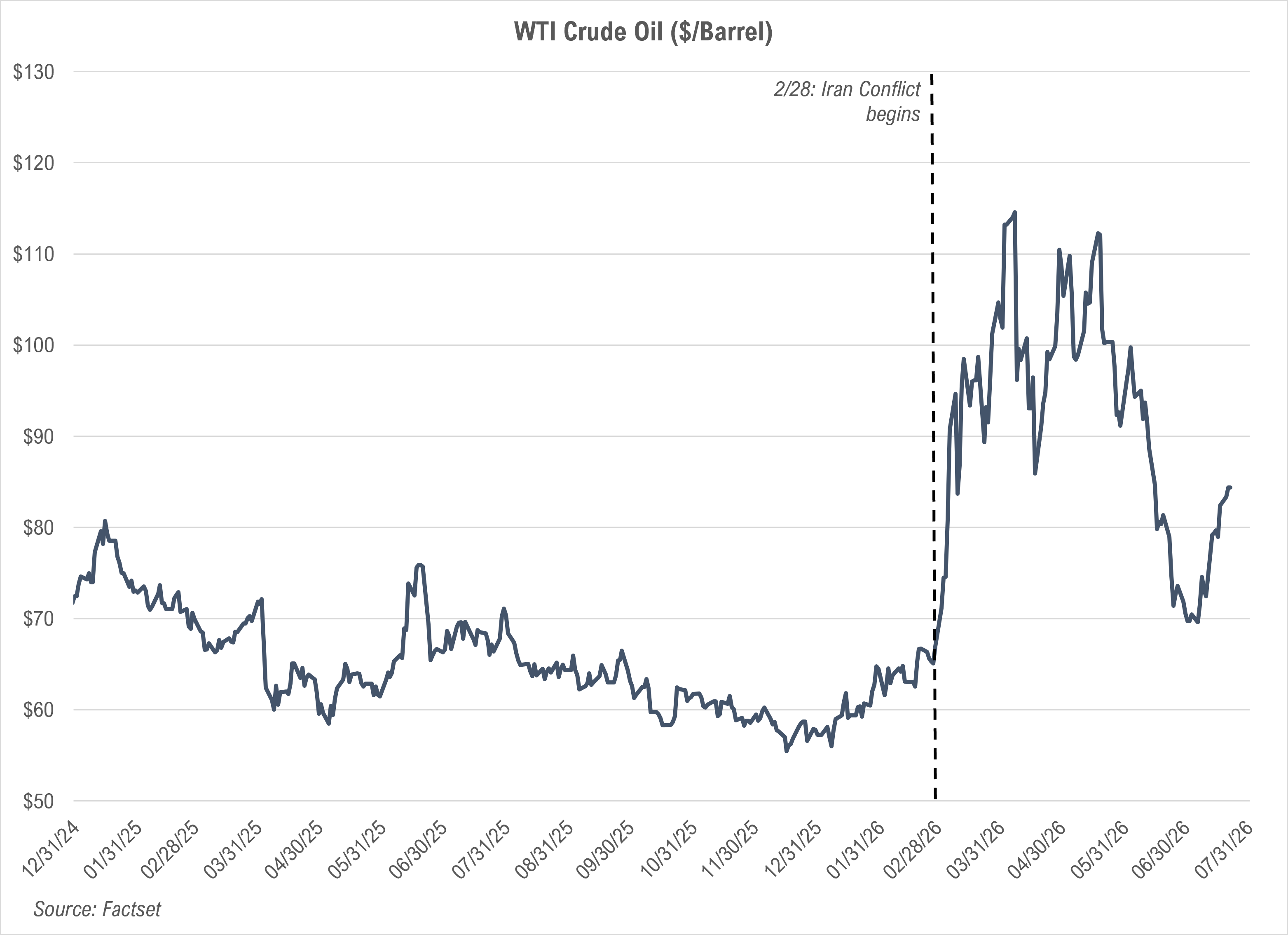
Encouragingly, financial markets absorbed the initial shock from the Middle East conflict better than many investors expected. Oil prices retreated from their wartime highs as supply conditions proved more resilient than initially feared, helping to ease pressure on consumers and inflation. More recently, though, renewed tensions have reminded investors that geopolitical risks rarely disappear altogether. Energy markets have adapted well so far, but the durability of that resilience, and its implications for inflation and monetary policy, remains an open question heading into the second half of the year.
That changing backdrop was reflected in recent inflation data. Consumer prices rose 3.5% in June from a year ago, down from 4.2% in May and below expectations, as core CPI eased to 2.6% from 2.9%. The report suggested that underlying inflation pressures kept moderating even after this spring's energy shock. For the Federal Reserve, however, one favorable reading is unlikely to resolve the broader policy challenge. June's data eased some of the immediate pressure, but renewed volatility in oil prices reinforces the need for patience until policymakers gain greater confidence that underlying inflation is still cooling and that any energy-driven price pressures prove temporary rather than becoming embedded more broadly throughout the economy.
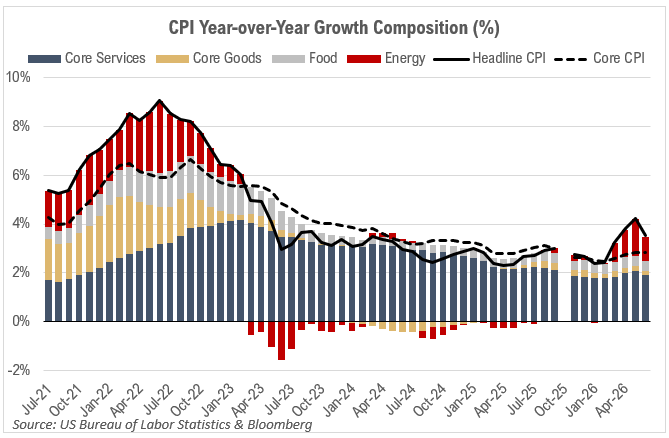
For many households, prices at the pump remain one of the most tangible barometers of inflation, and the recent relief there has been welcome. Average hourly earnings have risen 3.5% over the past year, essentially matching headline inflation. That marks an improvement from the temporary squeeze on purchasing power earlier this year, when surging energy prices outpaced wages. Even so, many families still feel the cumulative effects of several years of elevated costs for housing, food, insurance, and other everyday necessities. Inflation has moderated meaningfully, but the higher overall price level continues to shape how consumers view the economy and their own financial well-being.
Affordability will also shape the political backdrop as the midterm elections approach. Energy costs, housing, insurance, taxes, trade, immigration, healthcare, regulation, and federal deficits are all likely to receive more attention. Artificial intelligence is also moving from a market discussion to a political one as data-center growth raises questions about electricity costs, grid reliability, national security, and the distribution of AI's economic benefits. The investment question is whether policy outcomes improve or worsen inflation, labor market conditions, business confidence, credit conditions, and corporate earnings.
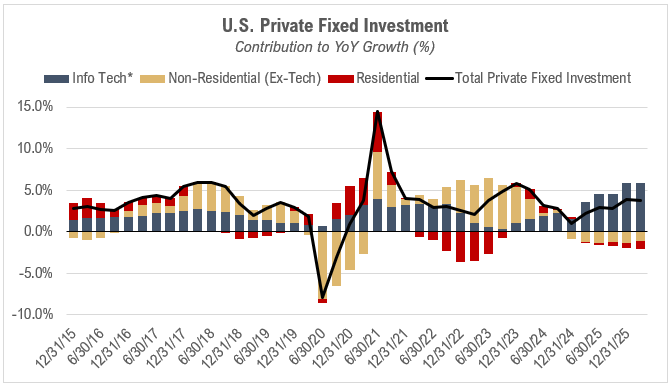
The current economy is less a single engine than two engines running at different speeds. One is powered by AI-related capital spending, high-end services, and large companies with strong balance sheets. Data centers, semiconductors, memory, networking and power infrastructure are all benefiting from the AI buildout, helping support jobs, revenues, earnings revisions, and market leadership.
The second engine has not stalled; it is simply moving more slowly as it works through higher borrowing costs, tighter credit, and elevated household expenses. Mortgage affordability remains difficult, commercial real estate refinancing is still challenging, and autos and smaller businesses remain exposed to higher financing costs. Aggregate consumption can look fine while many households feel more constrained.
Corporate earnings have been the clearest support beneath the market's resilience. After back-to-back years of double-digit earnings growth, S&P 500 profits are now expected to grow roughly 25% in 2026, up from expectations of about 15% at the start of the year. Revisions of that magnitude are unusual outside the early stages of recovery from a downturn, making this cycle notable: expectations are accelerating without a traditional recession-and-rebound setup.
AI is a major part of that story, but not the only part. Technology and communication services remain important drivers, yet every S&P 500 sector is currently expected to post positive earnings growth this year. Materials, consumer discretionary, energy, financials, and utilities are also expected to deliver double-digit gains. That breadth matters because it suggests the market is not relying solely on multiple expansion or a handful of mega-cap technology stocks, even though AI remains the dominant growth engine.
The AI buildout is still the most important earnings story within that broader profit recovery. It is not simply a replay of the late-1990s internet bubble, when many companies were valued on distant hopes with little current earnings support. Today's AI cycle is being funded largely by highly profitable companies, and many immediate beneficiaries are producing real revenue, margin, and earnings growth. J.P. Morgan’s Michael Cembalest estimates that since ChatGPT launched in November 2022, 42 AI-related stocks have contributed roughly three-quarters of S&P 500 price returns, nearly 90% of earnings growth, and three-quarters of capital spending and R&D growth.
Still, "real" does not mean "risk-free." The market has moved from asking whether AI matters to whether the return on AI spending will justify the scale. Tech giants are committing hundreds of billions of dollars to infrastructure. That spending may continue to rise into 2027, but the growth rate is likely to slow from extraordinary levels. For AI infrastructure companies already priced for very strong growth, deceleration can matter even if absolute growth remains strong.
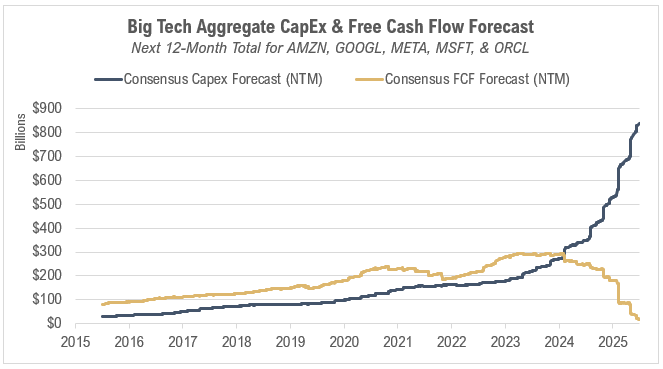
The sustainability question depends heavily on the AI labs and enterprise adopters. If AI models translate into durable revenue, productivity gains, and cash flow, the infrastructure cycle can remain well supported. If adoption takes longer, pricing falls faster, or monetization proves uneven, investors may begin to separate the strongest beneficiaries from the more speculative ones. Memory shortages, advanced packaging capacity, power availability, grid interconnection delays, and data-center construction timelines can raise costs or limit how quickly projects come online. The AI buildout remains one of the decade's most important themes, but it is entering a phase where execution and capital discipline matter more.
The IPO calendar will be another test of risk appetite. SpaceX's record IPO and the potential public listings of AI leaders such as OpenAI and Anthropic are not central to the outlook, but they are useful signals of whether investors are willing to absorb large new equity supply at elevated valuations.
For the second half, the constructive path begins with earnings. If energy prices resume easing, inflation moderates, and the Fed gains more flexibility, markets would have a stronger foundation for gains to broaden beyond the largest AI beneficiaries. Continued double-digit earnings growth from financials, utilities, energy, materials, and consumer discretionary would help reduce the market's dependence on AI infrastructure leaders. Additionally, the promise of higher productivity growth may eventually prove a boon to the rest of the economy.
The risk case is also clear. . With hostilities in the Middle East already flaring anew, a more prolonged conflict could keep headline inflation elevated and lead the Fed to remain on hold for longer or even push toward rate hikes. Long-term yields could back up again if inflation or deficit concerns rise. AI-related stocks could become more volatile if capital spending expectations slow, component shortages intensify, enterprise adoption disappoints, or investors question whether the labs can generate enough cash flow to justify the infrastructure being built around them. A heavier IPO and issuance calendar could also test market’s ability to digest surging equity supply.
Fixed income remains useful in this environment. Higher starting yields provide a real income cushion, and bonds can still play a stabilizing role in diversified portfolios. But rate volatility argues for balance across maturities, and tight credit spreads argue against reaching too aggressively for yield.
For long-term investors, the conclusion is not to ignore AI, politics, inflation, or geopolitics. It is to avoid letting any one of them dominate portfolio construction. AI remains a major long-term theme, but portfolios should not depend on a single investment cycle. The Iran War showed how quickly energy can reenter the inflation story. The Fed's caution showed that rate relief is not guaranteed. The market's narrow leadership showed that strong index returns can still mask meaningful dispersion.
As we move through the second half of the year, we believe the emphasis should remain on quality, valuation discipline, balance-sheet strength, and diversification. The upcoming elections will shed light on the issues that are most in focus for Americans. The investment landscape remains attractive, but equity markets are increasingly vulnerable to changes in the AI story. In a market shaped by AI investment, energy risk, policy uncertainty, strong but demanding earnings expectations, and elevated valuations, selectivity matters more than momentum.
Download 2026 Mid-Year Newsletter
First Merchants Private Wealth Advisors products are not FDIC insured, are not deposits of First Merchants Bank, are not guaranteed by any federal government agency, and may lose value. Investments are not guaranteed by First Merchants Bank and are not insured by any government agency. This material has been prepared solely for informational purposes. First Merchants shall not be liable for any errors or delays in the data or information, or for any actions taken in reliance thereon. Any views or opinions in this message are solely those of the author and do not necessarily represent those of the organization.
